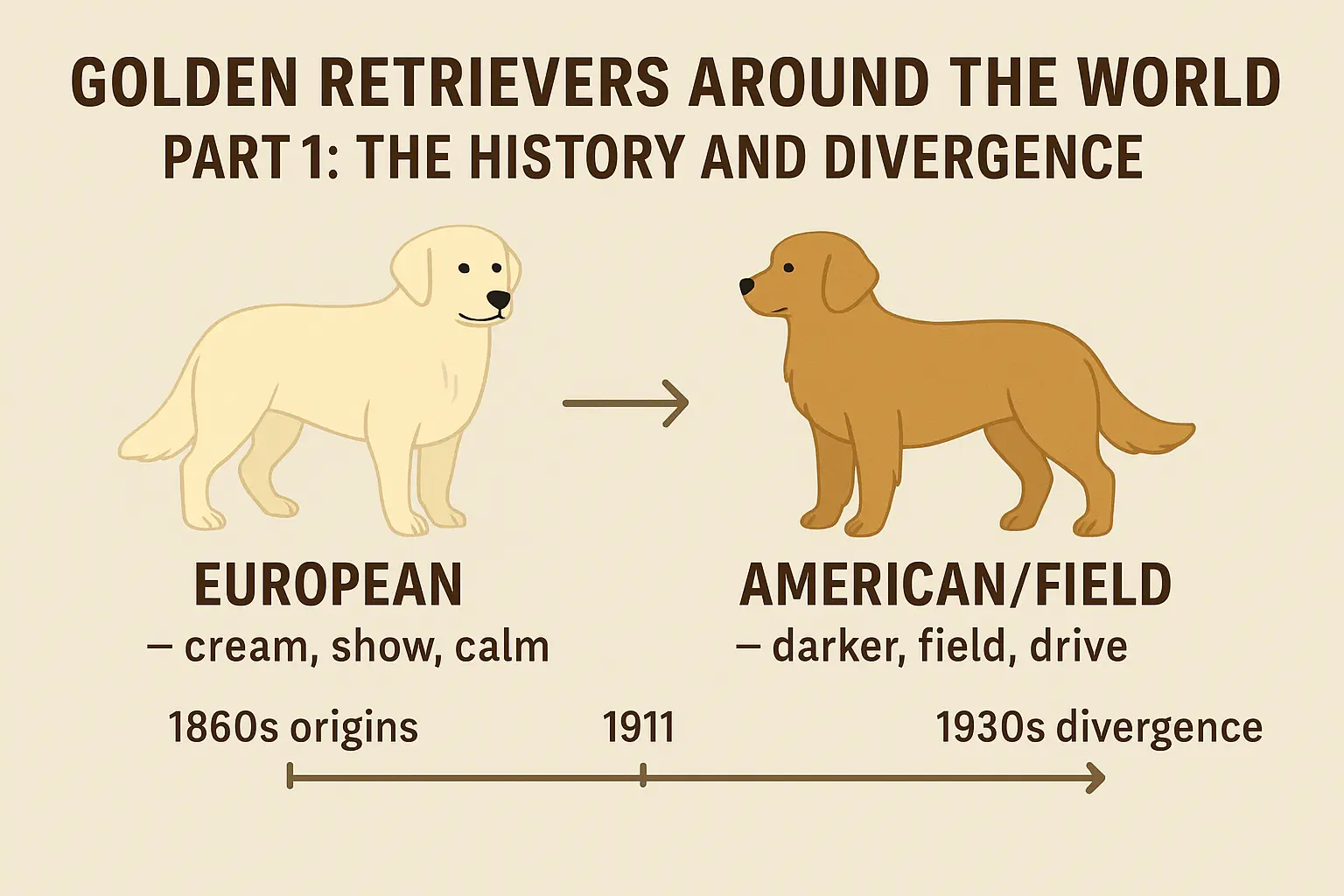
Golden Retrievers Around the World: Part 1 – The History and Divergence of Golden Retrievers
Golden Retrievers are one of the most beloved dog breeds in the world. Loyal, intelligent, and endlessly affectionate, they’ve captured hearts everywhere from the Scottish Highlands to bustling American suburbs. But if you’ve spent much time around Goldens, you’ve probably noticed something curious: they don’t all look the same. Some are pale and stocky with broad heads and teddy-bear faces, while others are lean, athletic, and a deep shade of red.
Why is there so much variety within a single breed? To answer that, we have to travel back in time and follow the Golden’s journey as it spread across continents and adapted to very different cultural values.
Origins in Scotland
The story begins in the mid-1800s at the Guisachan Estate in Scotland, where Lord Tweedmouth (Dudley Marjoribanks) set out to create the perfect gundog. He wanted a dog that could retrieve shot birds both on land and in water, handle the rugged terrain of the Highlands, and still be gentle enough to live inside the home.
He started with Nous, a rare yellow Wavy-Coated Retriever, and bred him with Belle, a Tweed Water Spaniel. Later crosses with Irish Setters and Bloodhounds added stamina, scenting ability, and structure. The early Golden Retrievers came in a wide range of shades—from pale cream to rich red—and were known for their soft mouths, eagerness to please, and versatility.
From the start, Goldens were bred to be both workers and companions, which is why they became so adaptable to different roles later on.
Recognition and Early Spread
By 1911, The Kennel Club in the United Kingdom officially recognized the breed under the name “Retriever – Yellow or Golden.” In 1920, the name was changed to simply “Golden Retriever,” solidifying their identity.
The breed’s popularity spread quickly. Canada recognized them in 1927, and the American Kennel Club followed in 1932. Early Goldens that made their way across the Atlantic were primarily valued as hunting dogs. At this point, there wasn’t a big difference between what you’d see in the UK and what you’d see in America, they all came from the same foundation.
But within just a few decades, the breed started to split into distinct “types,” shaped by the cultural priorities of each region.
The Divergence: UK vs. USA
By the 1930s through the 1960s, Golden Retrievers in the UK and the USA began to look and behave differently, not because they were two separate breeds, but because breeders on each side of the Atlantic wanted different things.
In the UK, hunting was slowly becoming more of an aristocratic pastime. Large estates had gamekeepers and professional handlers who worked the dogs. For the families who owned them, the dogs themselves didn’t need to be the high-energy athletes they once were. Instead, what caught people’s attention was the rise of the dog show. Conformation became the focus—structure, coat color, and ring presence mattered more than how far a dog could swim after a duck.
As a result, British breeders gradually favored dogs that were calmer, heavier-boned, and lighter in color. Cream coats became fashionable, and the blockier head shape we often associate with “English type” Goldens grew in popularity.
Meanwhile, in the United States, the story was very different. Hunting wasn’t limited to wealthy estates, it was a widespread tradition across rural America. Families used their own dogs to retrieve ducks, pheasants, grouse, and quail. Field trials became a booming sport, rewarding drive, endurance, and precision.
Because of this, American breeders leaned toward dogs that were more athletic, with higher stamina and greater drive. Darker golden coats, even deep reddish shades, became common. Some hunters even preferred these darker coats, believing they blended better with the landscape.
both “types” of Goldens came from the same original dogs, but cultural differences split them apart. In the UK, families wanted calm, show-winning companions. In the U.S., families wanted high-energy hunting partners. Neither direction was wrong, it simply reflected what people needed from their dogs.
A Timeline of Change
If we look at the big picture, the timeline of this divergence makes sense:
- 1860s–1890s: The breed is created in Scotland, versatile in color and purpose.
- 1911–1920: Recognized officially by The Kennel Club. Spread to Canada and the U.S. shortly after.
- 1930s–1940s: The first signs of divergence—UK breeders lean toward lighter coats and calmer temperaments; U.S. breeders lean toward darker coats and high drive.
- 1950s–1960s: The differences solidify. UK show Goldens are blocky, cream-colored, and steady. U.S. field Goldens are darker, leaner, and more energetic.
- By the 1960s, you could already look at a Golden and make an educated guess about whether it came from European or American lines.
Why This Matters
It’s easy to think of “English Goldens” and “American Goldens” as completely separate categories, but that’s oversimplifying. These are just tendencies. Breeding choices matter more than geography.
You can absolutely find an American-bred Golden that is calm, stocky, and pale. You can also find a European-bred Golden that is darker, leaner, and loves to work. The type of dog you get depends on what the breeder was selecting for, companion, temperament, show success, or hunting ability.
The key takeaway is this: the differences we see today didn’t happen by accident. They’re the direct result of what people valued in their dogs.
Looking Ahead
By the late 20th century, the story takes another turn: American breeders began importing European Goldens, which created new blends and blurred the lines between the two types. That’s where Part 2 of this series picks up.
In Part 2: Golden Retrievers Divergence To Diversity, we’ll explore how cross-Atlantic breeding changed the picture, what genetic studies reveal about the breed’s clusters, and why today’s Golden Retriever is more diverse than ever.